
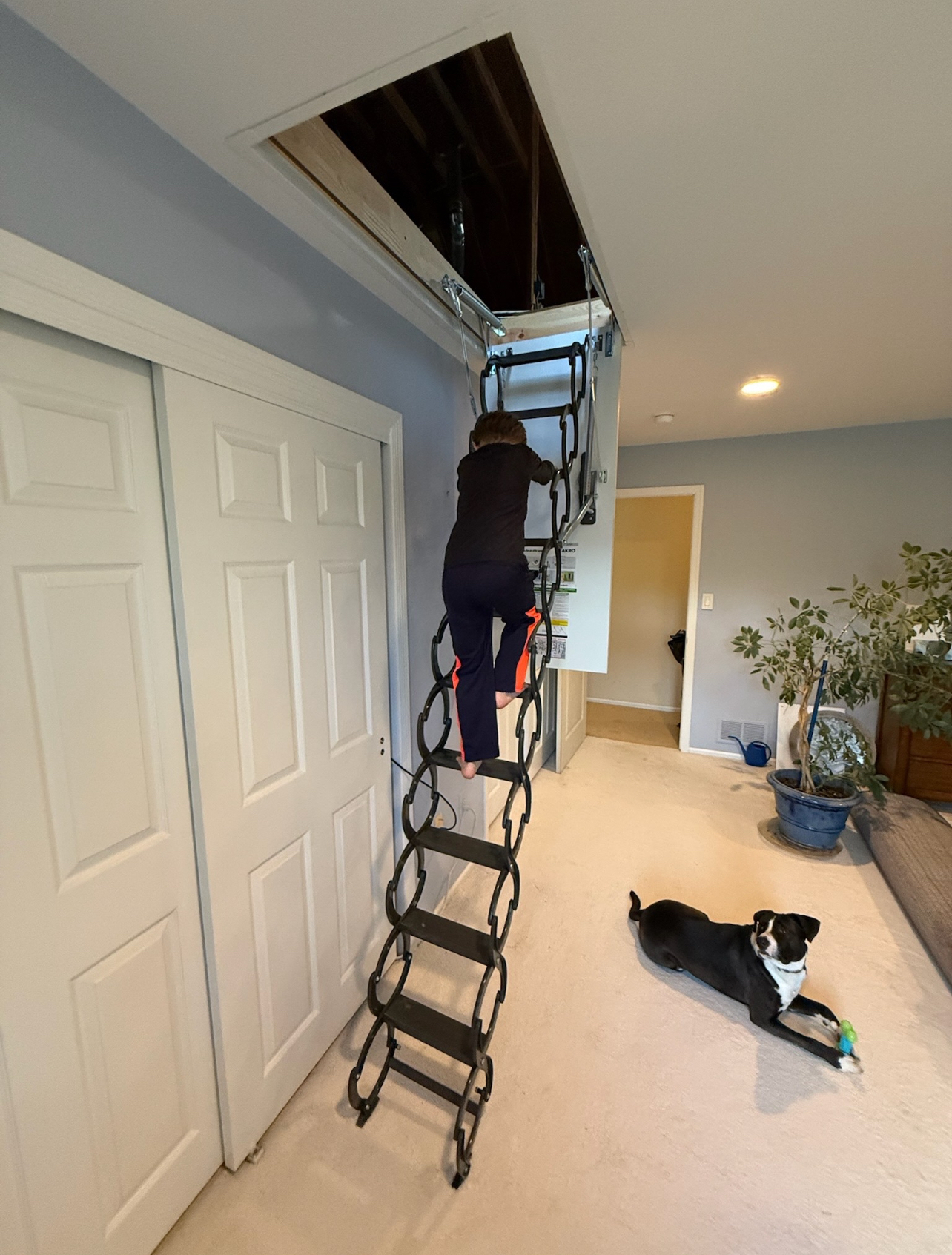
An attic ladder should do more than fold into the ceiling. It should open smoothly, stand firmly, fit the room without striking a wall or door, and close against a sealed, insulated hatch. If your current access is a loose plywood panel, a shaky pull-down staircase, or a drafty door that will not stay shut, the right FAKRO attic ladder can solve several problems at once.
For New Jersey homes, the model matters. Ceiling heights, joist layouts, openings, roof slopes and available landing space can vary significantly. FAKRO offers wood, metal, scissor, high-ceiling and fire-rated attic ladders, with different levels of insulation and safe-access features.
AtticCraft installs and replaces attic stairs across New Jersey. This guide combines current FAKRO USA specifications with lessons from real installations in Bayonne, South Plainfield, Wayne and Haworth so you can understand which option is likely to fit your home.
Quick answer: Choose the LWP for a practical insulated wood ladder, LWT Super Thermo for maximum insulation, LST for a compact scissor mechanism, LME for a heavy-duty metal ladder, LMP for ceilings up to 12 feet, and LWF60 or LMF60 when a verified 60-minute fire rating is required.

Why New Jersey homeowners choose FAKRO attic ladders
FAKRO’s US attic-ladder range is designed around common homeowner problems: unsafe access, limited room, air leakage, high ceilings and the need for a cleaner finished opening. The units are factory assembled with the frame and ladder, and insulated models conceal their hardware when closed.
- Insulated, gasketed hatches. The door closes off the attic more effectively than a loose plywood panel or a worn, warped hatch.
- Safe-access details. Depending on the model, these include non-slip treads, handrails, rubber-capped ladder ends, spring assistance and load ratings from 350 to 400 pounds.
- Choices for difficult spaces. Folding, scissor and high-ceiling designs give an installer more ways to solve limited swing clearance or unusual room geometry.
- Finishing and comfort accessories. Optional trim, an upper hatch, an extra tread and attic-floor handrails can improve appearance, cleanliness and the transition into the attic.
- Current limited warranty. FAKRO states that attic ladders carry a one- or two-year limited warranty depending on the model.
Manufacturer reference: FAKRO USA attic-ladder overview
Energy efficiency: the hatch is part of your home’s thermal boundary
An attic opening interrupts the insulated ceiling between the living space and the unconditioned attic. ENERGY STAR advises homeowners to treat an attic door like a door to the outside by insulating it and weatherstripping the edges.
A properly selected and professionally fitted FAKRO hatch helps reduce heat loss, limit cold drafts and keep the indoor climate more stable. That can also reduce unnecessary heating and cooling demand. The product’s R-value matters, but so do accurate sizing, level installation, perimeter air sealing and a latch that compresses the gasket consistently.
For an attic access point inside a hallway, bedroom or other conditioned area, the FAKRO LWT Super Thermo is often the strongest thermal choice in the residential line. FAKRO lists an R-value of 12.5, a 3 1/8-inch insulated hatch and three perimeter gaskets. The LTK Energy offers R-10, while the LWP provides R-5.7 for a more economical insulated wood option.

FAKRO attic ladder comparison for New Jersey homes
The table below focuses on the models most relevant to New Jersey replacement and new-opening projects. Exact compatible ceiling heights depend on the opening size, so the final selection must be checked against the current manufacturer chart.
| Model | Key facts | Best fit | Field note |
| LWP | Wood folding R-5.7 | 350 lb | Everyday insulated replacement | A practical choice when the opening and room provide normal folding clearance. |
| LTK Energy | Wood folding R-10 | 375 lb | Stronger insulation | A middle ground between the LWP and the highest-insulation LWT. |
| LWT Super Thermo | Wood folding R-12.5 | 350 lb | Best thermal performance in this comparison | Triple gaskets and a thick insulated hatch suit access points inside conditioned areas. |
| LME | Metal folding R-5.3 | 400 lb | Heavy-duty metal ladder | The highest listed load capacity in this homeowner comparison. |
| LST | Metal scissor R-5.2 | 350 lb | Tight openings or limited floor space | The scissor mechanism can solve layouts where a three-section ladder is awkward. |
| LMP | Metal folding R-5.2 | 375 lb | High ceilings up to 12 ft | An integrated unloading mechanism assists folding and unfolding. |
| LWF60 | Wood, 60-min fire-rated R-12 | 375 lb | Fire-rated wood access | High insulation plus ASTM E119 / NFPA 288 60-minute rating. |
| LMF60 | Metal, 60-min fire-rated R-8.9 | 350 lb | Fire-rated metal or taller layouts | Available in configurations for higher ceilings; verify the exact size chart. |
Specifications checked against FAKRO USA wooden ladders, metal ladders and metal scissor ladders. Product specifications can change; confirm the exact size and model before ordering.
Which FAKRO model should you choose?
Best for insulation: FAKRO LWT Super Thermo
The LWT is the leading choice when energy efficiency is the priority. Its R-12.5 hatch and triple-gasket frame help address a common complaint in New Jersey homes: feeling a cold draft around the attic opening in winter or unwanted heat entering the living space in summer. It is a three-section wood ladder with non-slip steps, a handrail and a 350-pound load rating.
Best practical wood option: FAKRO LWP
The LWP is a dependable insulated wood ladder for a straightforward replacement where the opening, ceiling height and floor space suit a folding design. It has an R-value of 5.7, a 350-pound load rating, a handrail, non-slip treads and rubber-capped adjustable ends. It is a sensible choice when you want safer access and a sealed hatch without moving to the highest-insulation model.
Best for tight spaces: FAKRO LST scissor ladder
The FAKRO LST insulated scissor attic ladder folds into a compact spring-loaded metal mechanism. It is especially useful where a three-section ladder would need too much swing or landing space. The LST has non-slip metal treads, an insulated and gasketed hatch, a 350-pound load rating, installation brackets, finished trim and a control rod.
Best heavy-duty metal option: FAKRO LME
The FAKRO LME insulated metal ladder has a 400-pound maximum load rating, the highest of the models compared here. Its three-section metal ladder includes a handrail, non-slip steps and rubber-capped adjustable ends. It is worth considering when a homeowner prefers a metal structure and the room has enough folding clearance.
Best for high ceilings: FAKRO LMP
The LMP is designed for ceilings up to 12 feet. Its integrated unloading mechanism helps control folding and unfolding, which is especially important because higher openings make overhead handling more demanding. High-ceiling installations are heavy and geometry-sensitive, so professional lifting, accurate leveling and a model-specific clearance check are essential.
When a fire rating is required: LWF60 or LMF60
FAKRO lists both the wood LWF60 and metal LMF60 with a 60-minute rating under ASTM E119 and NFPA 288. The LWF60 combines that rating with R-12 insulation; the LMF60 provides a metal ladder and configurations for higher ceilings. Fire-rated product selection should always be confirmed against the specific room, assembly and local code requirements – the product label alone does not determine code compliance.
Six measurements and checks that determine whether a ladder fits
The safest choice is not simply the model that matches the old trim. FAKRO’s pre-installation guidance calls for checking the rough opening, ceiling height, swing clearance, landing space, framing and attic-side obstacles before installation.
- Measure the true rough opening. Record the clear width and length inside the framing, not the decorative trim or the outside dimensions of the old ladder box.
- Measure floor-to-ceiling height. Each model and opening size has a minimum and maximum compatible height. A ladder outside that range should not be improvised.
- Check swing clearance. A folding ladder needs room for its sections to pass through the opening without hitting a wall, door, railing, light fixture or parked vehicle.
- Check landing space. When fully opened, both ladder feet must sit securely on the floor at the intended angle.
- Inspect the attic side. Roof slopes, ducts, pipes, electrical wiring, storage platforms and mechanical equipment can block the ladder or make the opening unsafe.
- Assess the framing. Joists and trusses determine whether the existing opening can be reused, resized or moved. Structural members should not be cut without appropriate professional review.
Planning reference: FAKRO attic-ladder pre-installation guidelines

What real New Jersey installations teach us
Bayonne: replacing plywood access with an insulated LWT
A Bayonne homeowner had an attic opening covered only by plywood. There was no integrated, dependable ladder and the opening did not match a standard unit. AtticCraft made the opening slightly longer and narrower, installed a 25 x 54-inch FAKRO LWT Super Thermo, added new trim and protected the surrounding walls during the work. The result combined safer built-in access with a sealed, highly insulated hatch.

South Plainfield: scissor stairs and an attic-floor handrail
After hip surgery, a South Plainfield homeowner wanted a more secure way to reach the attic and more confidence during the transition at the top. The compact FAKRO LST steel scissor ladder fit the layout, and an LXH-A floor-mounted attic handrail added a stable support point when stepping into or descending from the attic. This is a good example of why safe accessibility must be planned for the entire climb, not just the ladder itself.

Haworth: confirming that the ladder would clear a wall
In Haworth, a wall above a doorway created a real risk that the folding sections could strike it while opening. The ladder could not simply face the other direction because the roof was in the way. The homeowner sent photos and the required measurements; AtticCraft obtained a factory drawing the next day to confirm the geometry before scheduling the work. The installed stairs fit the available space and felt secure – without relying on guesswork.

Wayne: moving access out of a cramped wall closet
A Wayne homeowner’s old attic access was inside a narrow wall closet. Reaching it required emptying the closet and bringing in a separate ladder. The attic also contained ventilation pipes and cables, so location mattered. After evaluating the structure and headroom, AtticCraft created a new opening in a guest room and installed an LWT Thermo with narrow trim. The homeowner could finally stand upright and use the attic through a safer, more convenient access point.

What professional FAKRO installation includes
A quality attic-ladder installation is a fit, structure, air-sealing and finishing project – not just a matter of screwing a box into the ceiling.
- Remote or on-site assessment. AtticCraft reviews the rough-opening measurements, ceiling height and photos from both sides. Complex clearances or new openings may require an on-site visit.
- Model and size verification. The team checks the FAKRO size chart, opening orientation, swing and landing space, roof clearance, obstructions and any safety accessories.
- Home protection and preparation. Floors, walls and nearby furniture are protected before the old unit is removed or a new opening is created.
- Level, secure and sealed installation. The frame is installed square and level, the ladder is adjusted to the finished floor, the perimeter is sealed and the hatch is tested for consistent closure.
- Trim, cleanup and handover. The opening is finished neatly, the work area is vacuumed, and the homeowner is shown how to open, close and use the ladder safely.
Many straightforward replacements can be completed in a few hours. A new opening, major resizing, unusual framing or difficult attic obstructions can require more time. The schedule should be based on the actual home rather than a generic promise.
See AtticCraft’s complete attic ladder installation process in New Jersey for the measurements and photos needed for a quote.

How much does FAKRO attic ladder installation cost in New Jersey?
The installed price depends on more than the ladder itself. A direct replacement into a compatible framed opening is different from creating a new opening or changing structural framing.
- FAKRO model, size and accessories
- Whether the existing rough opening can be reused
- Ceiling height and the weight of the selected unit
- Framing changes or a completely new opening
- Roof, duct, pipe, wiring or door-clearance constraints
- Trim, drywall and finishing work
- Safety additions such as an attic-floor handrail or extra tread
The lowest-priced ladder can become poor value if it does not fit the room, leaves drafts around the hatch or creates an uncomfortable climbing angle. AtticCraft provides a project-specific quote after reviewing the opening, height, photos and the homeowner’s priorities.

Frequently asked questions about FAKRO attic ladders
What is the best FAKRO attic ladder for a New Jersey home?
There is no single best model for every home. The LWT is the strongest choice for insulation, the LWP is a practical insulated wood ladder, the LST solves many tight-space layouts, the LME offers a 400-pound metal ladder, and the LMP is designed for ceilings up to 12 feet.
Which FAKRO attic ladder is the most insulated?
Among the standard residential models compared in this guide, the LWT Super Thermo has the highest listed R-value at R-12.5. The LWF60 fire-rated wood ladder is close at R-12, and the LTK Energy is R-10.
Can a FAKRO ladder fit my existing attic opening?
Often, yes. The installer must measure the framed rough opening, not just the visible trim. If it does not match an available size, the opening may be reframed or a different model may be selected. The framing and nearby obstacles determine what is practical.
Is the LST scissor ladder better than a folding ladder?
It is better for certain spaces, not universally. The LST’s compact scissor mechanism is useful when folding sections would hit a wall or need too much floor space. A wood folding ladder may feel more familiar and can offer higher insulation in models such as the LWT.
Are FAKRO attic ladders safe?
FAKRO models include features such as non-slip steps, handrails and published load ratings. Safe accessibility still depends on selecting the correct size, installing it square and secure, setting the feet correctly, maintaining clear landing space and using the ladder as directed. Optional attic-floor handrails can make the top transition more secure.
How long does a FAKRO attic ladder installation take?
A straightforward replacement is often completed in a few hours. A new opening, structural changes, unusual ceiling height, limited attic access or finishing work can extend the project. Photos and measurements allow a more accurate estimate.
What should I send AtticCraft for a quote?
Send the rough-opening width and length, the floor-to-ceiling height, and clear photos of the opening from the room and attic sides. Also show nearby walls, doors, stairs, fixtures, ducts, pipes or roof slopes that could affect clearance.
Choose a FAKRO ladder that fits the home – and the homeowner
A successful attic-ladder project balances five things: fit, safe accessibility, insulation, ease of use and a clean finish. FAKRO’s range gives New Jersey homeowners several strong options, but the measurements and room geometry must lead the decision.
AtticCraft handles the full process, from model selection and clearance checks to installation, air sealing, trim and safe-use guidance. The company is registered with the New Jersey Division of Consumer Affairs as a Home Improvement Business Contractor (license 13VH13547500).
Ready to replace unsafe or drafty attic access? Call or text AtticCraft at 973-801-0875, email info@atticcraft.com, or request a consultation online.